Showing posts with label EN. Show all posts

2015/06/17

Twitter #BRUinBER

At a Brussels-Alumni-Event (16 June 2015, Belgian Embassy in Brussels), the Belgian Minister of Finance Johan Van Overtfeldt (Nieuw-Vlaamse Alliantie, separatist/national-conservative Flemish Party) held a short talk. He spoke about an informal meeting with his German colleague Wolfgang Schäuble. Of course, everything informal nowadays is on Greece. The Belgian Minister said he had pointed out to mister Schäuble that the crisis was the chance to carry the European integration to the next level and rectify some important shortcomings of the monetary union. After being asked directly, he admitted that the social situation in Greece was a »drama«. Nevertheless the next steps for him are (neoliberal) reforms – which the Greek government refuses for the time being.

Of course, things like this are made to be put on social networks ...
https://twitter.com/hashtag/BRUinBER?src=hash

Twitter: #BRUinBER | Bildschirmdruck: dia-eu

2014/12/18

The Sleepwalkers (Christopher Clark) and Joyeux Noël (a film by Christian Carion)

As the Christmas Movie Night in the Chapel of Europe (www.ressurection.be) was an event that drew the attention to the film Joyeux Noël, I want to share some thoughts on that movie with the book The Sleepwalkers by Christopher Clark as an intellectual background. While the film tells the story of the Christmas truce 1914, an unofficial ceasefire in World War I, Christopher Clarks tackles the question how Europe went to war in the first place.
I am especially interested how advisors in government decision making used representations of Europe to legitimize particular actions. That is why a scene in which an Anglican bishop is bringing the soldiers back on the battle track in a sermon especially struck me. When he is preaching on more or less the forces of good against the forces of evil, I see this as an example of the narrative of an righteous Europe against a dark Europe. When we look with Clark at the political culture that brought Europe’s men to this not so merry Christmas situation 1914 the question remains: Was it a crime or a tragedy (p. 561)?
In good Anglo-saxon tradition, Clark writes in vivid, capturing style and starts his story how Europe went to war with a personal story in the acknowledgments. As a nine-year-old, he talked to his great-uncle Jim (p. xvi):
I asked him whether the men who fought in the war were scared or keen to get into the fight. He replied that some were scared and some were keen. Did the keen ones fight better than the scared ones, I asked. ›No‹, said Jim ›It was the keen ones who shat themselves first.‹ I was deeply impressed by this remark and puzzled over it – especially over the word ›first‹ – for some time.
Family vase from Jerusalem | (c) dia-eu
When I read this I realized that there is only one story I can recall being told in our family on World War I. Maybe I am typically German in this respect, the stories from World War II are probably responsible for the lack of remembrance of the trenches, of the No Man’s Land and so on.
My grandfather was born in Jerusalem and there are a few items that still remind me of this unusual fact for a German. One of them is a vase ornamented with Arabian characters. A part from being a remnant of this Jerusalem early youth it also is a symbol that the family did not have the chance to take a lot of their belongings with them when they were forced to leave the city in 1917 as the »World War« did not exclude the Near and Middle East.
All of this, the Christmas truce, the World War coming to the holy city and the Australian great-uncle talking about keen and scared soldiers seem absurd and far away to me. But I admit that there are similarities between our situation today and 1914, even if I am sceptical on some of the comparisons that Clark unfolds, for example the Eurozone crisis and the pre-war insecurities (p. 555). Just like our decision makers of 1914, are we sleepwalkers today, »watchful but unseeing, haunted by dreams, yet blind to the reality« (p. 562)?

2014/11/27

Robert Harris: Fatherland (1993)

The year 2014 is of course the remembrance year of countless real events in connection with the beginning of the really dark Europe: World War I (100 years) and World War II (75 years). But I will not remind anybody of real events, but of the contra-factual idea that the British author Robert Harris brought to live in his 1993 novel Fatherland. The action takes place in a very different Berlin 1964, so 50 years before our actual reality. Example of a news bit cited in one of the introductory sections of the novel:
Herbert von Karajan to conduct a special performance of Beethoven’s Ninth Symphony – the European anthem – at the Royal Albert Hall in London on the Führer’s birthday.
It is a European dystopia that is unfolded bit by bit while a German police officer of the criminal police investigates in a series of murders that are connected to highest circles in the German Reich which has more or less won World War II in Europe: The European Community is in existence, consisting of twelve European nations under the domination of Germany. Albert Speer’s Berlin has been built, including a European Parliament on one of the gigantic axis. The flag with the swastika in front of this Parliament is twice as big as the one of the rest of the sattelite states.
It is pretty clear that Harris just did not like the idea of European integration very much when he wrote this detective story with a political message. Even if one likes European integration, the story still leaves an impression. I kept thinking in the process of reading that the author and the cover editor of some editions took it a little to far with the integration bashing. But I have to admit that it is quite fun for those who are vulnerable to the question: »What if...«
I got the message... | en.wikipedia.org

I will not be a spoiler, if you are one of those people intrigued by contra-factual history, you should read for yourself. But I will be a typical historian: Some of the facts and details that Robert Harris brought together some 20 years ago (he is using original documents and historical persons partly) seem to be researched rather quickly and without much accuracy.
In a time when the European integration utopia style is still oftentimes believed to be irreversible, it might be a good idea to look in this very British dark Europe to be reminded that everything human might turn out a whole lot different than the original idea.

2013/09/27

European Research Conference – Housing First. What’s Second?

Since 1989, FEANTSA (European Federation of National Organisations working with the Homeless) is working in Brussels as a European non-governmental organization. Recently, the 8th European Research Conference of FEANTSA took place in Berlin. The issue at hand was a North-American program and its usefulness for European situations: »Housing First. What’s Second?«
Housing First. What’s Second? Greece is staying on the agenda – (c) dia-eu

Homelessness in a Europe marked by crisis is an increasing phenomenon. Still, maybe the question is allowed if a program from very different national background is fitting for different European situation. This would be a more fundamental question than the question asked by the conference. Is a program relying heavily on consumer choice and self-determination ideas working for example in a still existing social welfare system as for example in Germany? One of the keynote speakers in the plenary session, Volker Busch-Geertsema, was stressing a positive answer to this basic question anyway, promoting his own research project funded by the Directorate General Employment, Social Affairs and Inclusion of the European Commission. It is called Housing First Europe and provides interesting examples of good-working Housing First Projects (www.housingfirsteurope.eu). Unfortunately, up until now there seems to be only data from Budapest (kind of), Copenhagen, Glasgow and Lisbon. Would the results be equally good if one tries the Housing First approach, say, in Berlin?

One of the issues discussed in detail was the question of evictions due to rent arrears. A comparative analysis of evictions in 14 countries (Austria, Belgium, Czech Republic, Germany, Denmark, Spain, Finland, France, Ireland, The Netherlands, Poland, Portugal Sweden and United Kingdom) made it clear that more research on a European level is needed. The researcher, Susanne Gerull, estimated the number of homeless people in Germany to be comparatively low due to strong legal protection of tenants in the discussion. The question remained how viable those estimations/numbers are as there are different legal systems, different definitions of homelessness and different (national) statistical offices working very differently. Maybe an improvement of this situation would be to include homelessness in the poverty indicators set up by the European Parliament and to have statistics by Eurostat on the question of homelessness European-wide (feantsaresearch.org).

2013/07/27

The Shadow of General Charles de Gaulle

The (European) federalists may hope for a European Convention to cope with the multiple situations of crisis the European Union (EU) is facing. On this, I found a good post using my blogroll (http://foederalist.blogspot.de/2013/07/warum-wir-einen-europaischen-konvent.html). The German government seems to be rather satisfied with an approach of »muddling through«, at least for the time being – which has probably a lot to do with the upcoming elections. An important figure which overshadows the European project to this day ist often overlooked: General Charles de Gaulle. Actually, the mythical General of French history (the title of today’s post is almost identical to a well-written book by Sudir Hazareesingh on the topic) influences the intergovernmental bias the European integration has developed over the years. Examples:
  • The European Council, initiated by de Gaulle’s successor Valéry Giscard d’Estaing much in line with the General’s ideas of strong nation states.
  • The tradition according to which some policy fields in the European framework are treated intergovernmentally and oftentimes necessitate unanimous decisions (starting with the »Luxembourg compromise«, continuing with the »pillar structure« of the Maastricht treaty and still going strong with the European Stability Mechanism (ESM) as an independently signed treaty).
  • Different political groups supporting euro-scepticism almost allover Europe which claim de Gaulle as a symbol from time to time and a problemtaic relationship with the Southern Mediterranean or »l’Afrique du nord« (the photograph of 2008 shows a memorial in the 6th arrondissement, which sidesteps the term »Franco-Algerian War« for the 1950’s and 1960’s).
Memorial, 6th arrondissement, Paris – HOMMAGE AUX HABITANTS/DU 6e ARRONDISSEMENT/MORTS POUR LA FRANCE/EN AFRIQUE DU NORD/ENTRE 1952 ET 1962 [...] – EN: HOMAGE TO THE INHABITANTS/OF THE 6th ARRONDISSEMENT/WHO DIED FOR FRANCE/IN NORTH AFRICA/BETWEEN 1952 AND 1962 [...] – 2008 (c) dia-eu
In 2014, there are not only European elections and probably a »bumper crop of euro-skeptics and political radicals« (Paul Taylor for the International Herald Tribune, 2nd April 2013, p. 20) filling the European Parliament (EP). It will also be the 70th anniversary of General de Gaulle’s triumphant victory with his parade on the Champs d’Élysée. Maybe this will also be the time to remind the Europeans of his long shadow.

2013/02/09

The Bees, the Flowers and the European Food Safety Authority

As the following video is available only in English it would be much ado about nothing to comment on it in German – even more so as the European agency in question seems to be more recognizable under its English acronym EFSA than under its German title (Europäische Behörde für Lebensmittelsicherheit). Anyway, as the agencies of the European Union are scattered all over the continent the organization »committed since 2002 to ensuring that Europe’s food is safe« happens to be situated in Parma, Italy. Probably sending her message to the final frontier of virtual space called Internet from there, a lady with a nice Romanic accent explains why Bees are under threat. Not so long ago, the EFSA issued a press release that dealt with one critical point in the video (around 1:40): The harmful effects of pesticides for our small little honey-helpers. Neonicotinoids not only sound ugly, it is likely that at least three types of these substances pose a risk to bee colonies – clothianidin, imidacloprid and thiamethoxam.

As there are consultations in Brussels going on since late January whether or not the use of these neonicotinoids should be restricted in the European Union, these issues have news value. The petition power of the Internet is on its way, with the platform avaaz.org claiming to have millions of digital signatures for a ban of »bee poison«. Even though the bees, the flowers and the lady of EFSA in the video have only a few thousand clicks, I would recommend not only to sign a petition but also to watch the video or even read the press release. The success of the documentary »More than Honey« is another indicator that it is more at stake than a dark full-grain bread with golden honey for breakfast.
Press release of EFSA: http://www.efsa.europa.eu/en/press/news/130116.htm

2012/08/27

Tempelhof Airport – the European Grandmaster of Noise

Especially for global p(l)ayers, the former airport in Berlin-Tempelhof seems to have a fascination going way beyond practical aspects. Newest example: »Campus Party™ – Europe in Berlin« with its main actors Telefonica | O2 and the European Commission. The weather was not the best during the time span 21st to 26th of August and – even worse – the airplane hangars provide for horrible acoustics if there are as many stages as in this case. This holds true even though or precisely because not all seats were in use in front of every stage. Tempelhof seems to have enough tech-appeal to be the place for hackers, bloggers and wannabes (like me).
The panel I discuss here had the interesting title »Tools and Strategies to hack the European Union«. Noteworthy on a stage paid for in part by the European Commission, that is. Discussiants were Sandra Mamitzsch (Digitale Gesellschaft e. V.) and Katarzyna Szymielewicz (Panoptykon), both active in the umbrella organization EDRI (European Digital Rights). Of course, the panel seemed a little hyped by the vote against the ACTA treaty. Katarzyna Szymielewicz, who is also a member of the EDRI Board, started the panel with a »commercial« for EDRI and its main issues.
Even though there was a serious effort by both discussants to not talk too much about ACTA, the issue came back in the game when they went into the campaigning challenges. The easy aspect of the European Parliaments vote was in the view of both activists that it was just necessary to get the Members of Parliament to vote against the proposed regulation. Understandably, it is much more difficult to bring forward an initiative, e. g. for a reformed copyright.
At this future-oriented part of the discussion the mentioned Tempelhof atmosphere was taking its toll more and more. As Katarzyna Szymielewicz was explaining why »self regulation« in the Internet sector does not always work in a good way, the noise on the main stage just a few meters away reached crisis level. The »hacking attempt« against the European Union had to be aborted. By the way, on the main stage Neelie Kroes, the European Commissioner for Digital Agenda, was enjoying the acoustic aura.

2012/06/13

Istanbul and the »Middle Age«

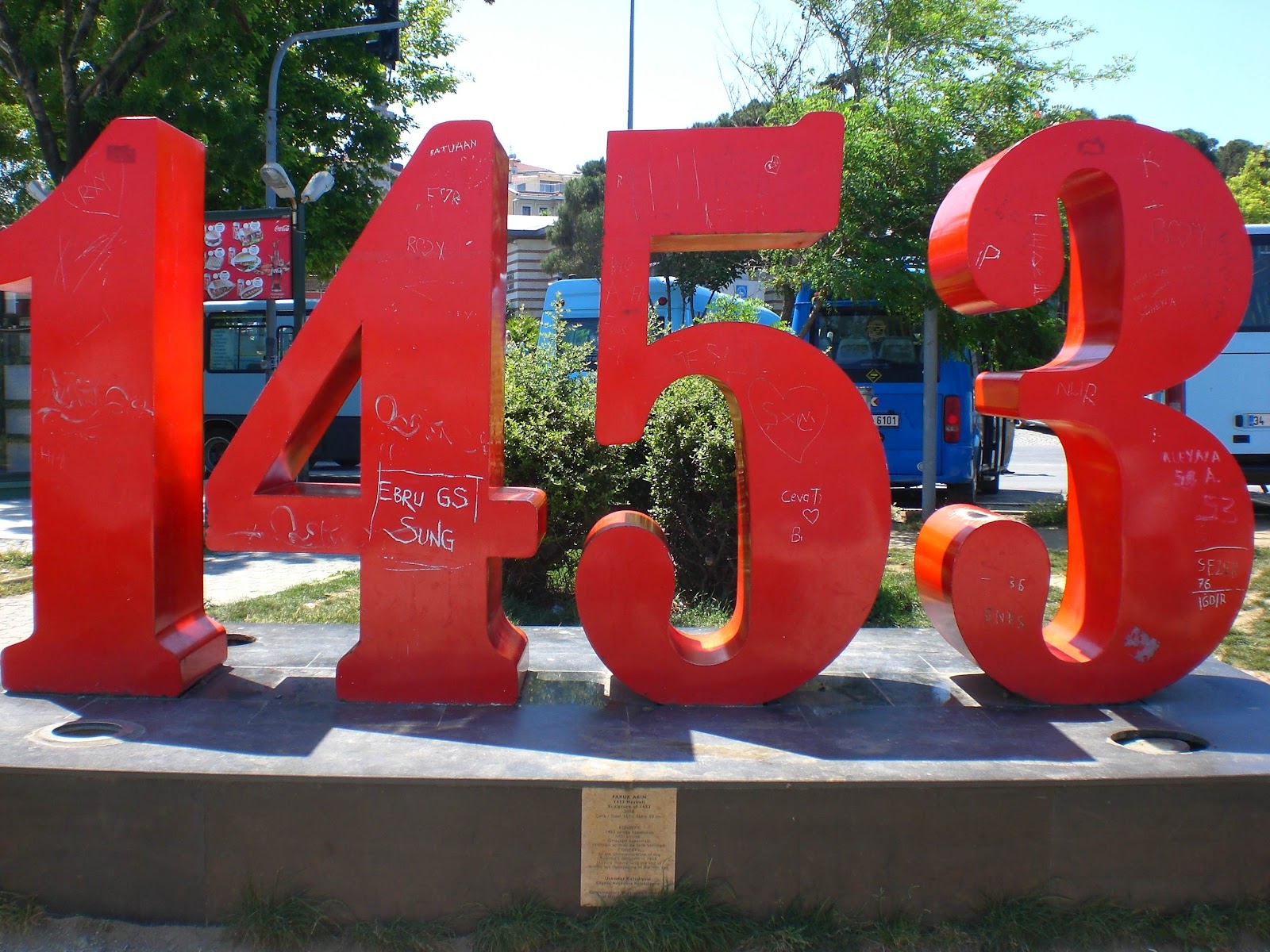
As I had the opportunity to learn a lot about Europe, Turkey and other entities this weekend, just a small remark regarding a question that touches the so-called periphery of Europe: What do we do with such a breathtaking place as Byzantium/Constantinople/Istanbul? At least the answer of the »Sculpture of 1453« by Faruk Akin on the eastern shore of the Bosporus is kind of clear: »CONCEPT: to the commemoration of the Istanbul’s conquest in 1453. History making with the end of middle age the opening of the new age«. To be correct, the English version of it, as I can’t read Turkish, there might be some other idea behind it depending of the language...
»Sculpture of 1453« | (c) dia-eu

»Sculpture of 1453« (inscription) | (c) dia-eu